
Mary Help of Christians
Feast Day: May 24
The title Mary Help of Christians traces its origins to a pivotal moment in Christian history: the Battle of Lepanto in 1571. Faced with overwhelming forces from the Ottoman Empire, Pope Pius V called on all Christians to pray the Rosary for victory. Through these prayers, the Christian fleet triumphed, a victory attributed to the intercession of the Blessed Virgin Mary. In gratitude, the Pope instituted the title Mary Help of All Christians, honoring her role as protector of the faithful. This victory also established October 7 as the feast day of Our Lady of the Rosary, a title Mary received for her help in this decisive battle, and she became known as Our Lady of Victory.
Centuries later, devotion to Mary Help of Christians was profoundly embraced by St. John Bosco, founder of the Salesian family. In 1862, he had a prophetic dream known as the Dream of the Two Pillars. In this vision, the Church was represented as a ship facing attack from enemy forces, while two pillars symbolized devotion to Mary Help of Christians and the Holy Eucharist. These pillars offered stability and protection, conveying a powerful message: the future of the Church is secure when the faithful remain committed to these devotions. Inspired by this dream, Don Bosco founded the Association of Mary Help of Christians in 1869, aiming to promote devotion to Mary and the Eucharist, particularly among youth.
Don Bosco’s love for Mary Help of Christians also inspired him to build a church in her honor. He recounted two visions that guided him: the first revealed the need for a refuge for those in need, and the second indicated the sacred location, where three Roman soldiers had been martyred. With unwavering faith and only two pennies in his pocket, Don Bosco began construction, confident in Mary’s protection. His trust was summed up in his words:
“Entrust everything to Jesus in the Blessed Sacrament and to Mary Help of Christians and you will see what miracles are.”
The resulting church became not only a place of worship but also a testament to the power of faith, prayer, and devotion to Mary as a guiding help for all Christians.
From the Battle of Lepanto to the work of Don Bosco, Mary Help of Christians remains a powerful symbol of guidance, protection, and maternal care for the Church and for all who turn to her in prayer.
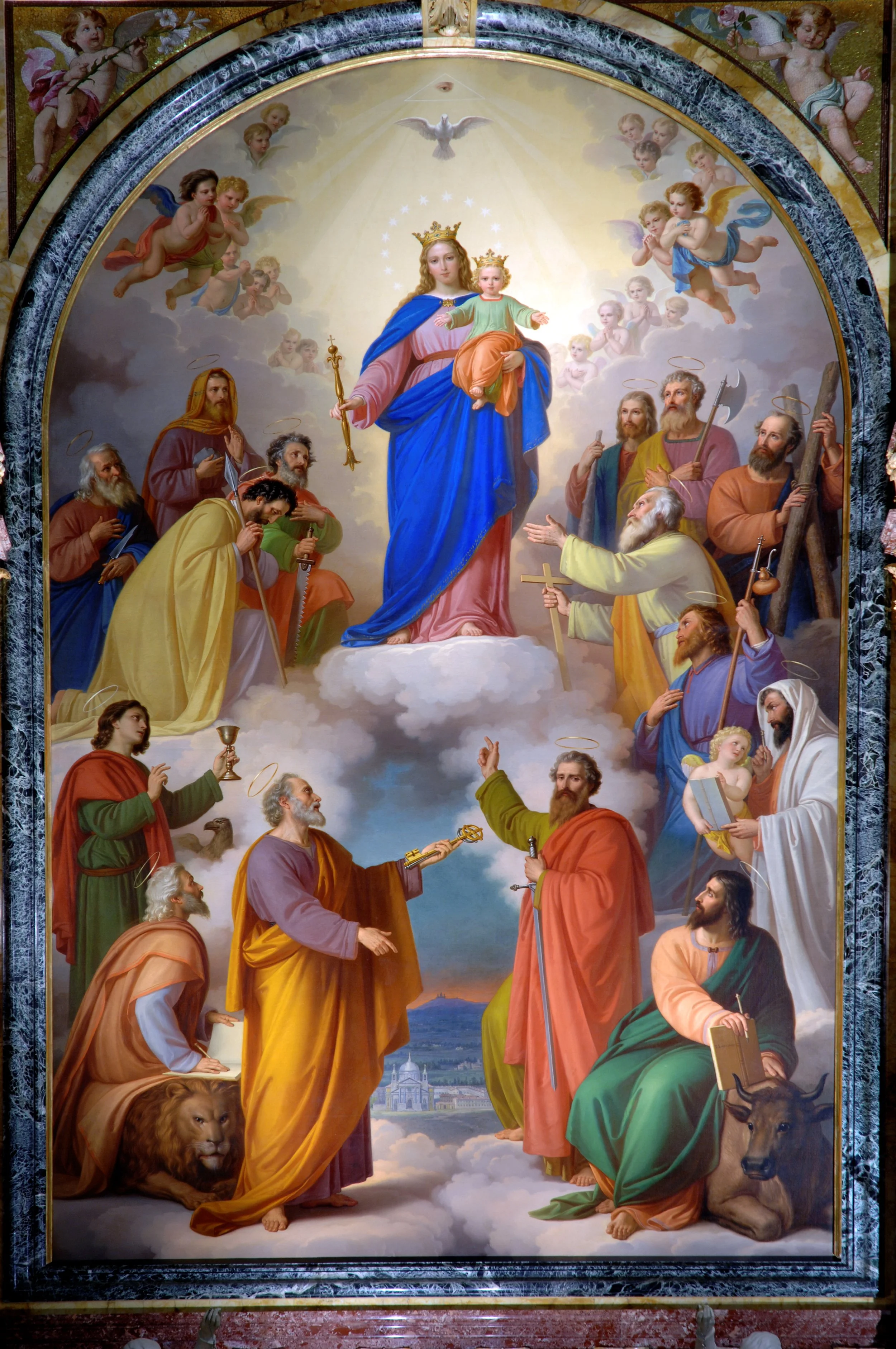
Don Bosco envisioned the image of Mary Help of Christians as a majestic, heaven-filled scene. Mary stands radiant in light as Queen, holding a scepter in her right hand and the Child Jesus in her left—Jesus extending His arms in mercy toward all. Angels surround her in homage, while the Apostles and Evangelists below gaze upward in awe, proclaiming her as Regina Apostolorum. At the bottom appears the city of Turin, with Valdocco in the foreground and Superga in the distance. Don Bosco intended the painting to express the profound truth of Mary as Mother of the Church and Help of Christians, creating a powerful visual catechesis that inspires devotion in all who contemplate it.
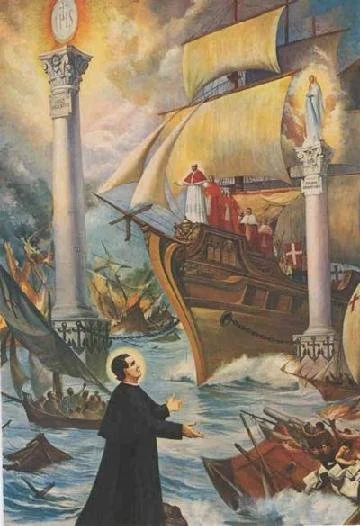
In Don Bosco’s dream, the Church appears as a great ship sailing through violent, enemy-filled waters. The Pope stands at the helm, guiding it while hostile vessels attack from all sides. Amid the chaos, two towering pillars rise from the sea: one crowned by the Eucharist and the other topped by the Blessed Virgin Mary under the title Mary Help of Christians. The Pope anchors the ship to these pillars, and once secured, the storm calms, the enemies scatter, and peace is restored. The dream symbolizes the Church’s safety and triumph when it remains firmly anchored to the Eucharist and devotion to Mary.